
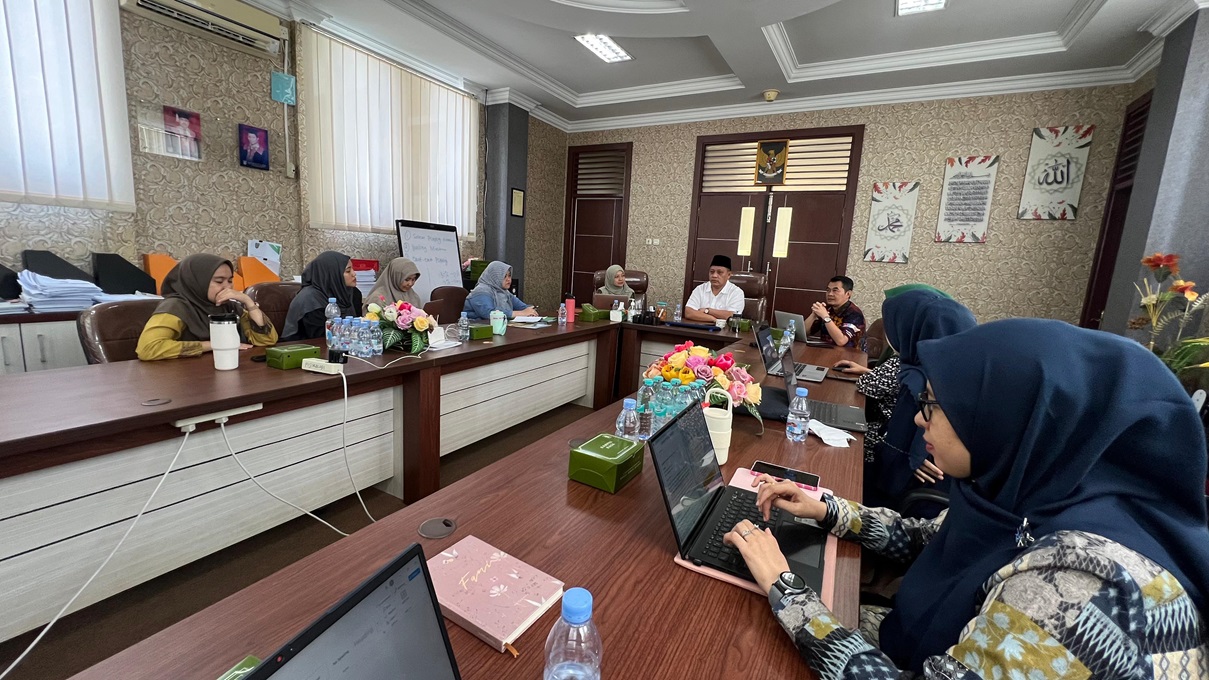
On Saturday, September 26, 2025, the Psychology Meeting Room hosted an inspiring and visionary discussion. Titled “Sharing Session with Dr. Aini Maznina,” the meeting provided profound insights into the future of research within Islamic higher education. Notetakers Didik Widiantoro, M.Psi., Psychologist and Irfani Rizal, M.Psi., documented the crucial points discussed.
The session began with a fundamental presentation from Dr. Aini, who stated that research conducted in Islamic universities has the potential and responsibility to transcend conventional scientific approaches. The key is to integrate Islamic epistemology into the heart of research activities. This is not merely about adding quotations from the Qur’an, but about building a holistic research paradigm.
Integration Research: A New Framework
Dr. Aini outlined three strategic steps in this integration process, explained as “Adopt, Formulate, and Develop.”
-
Adopt: The first step is to broaden the foundation of knowledge. In integrative research, the sources of knowledge are not reliant solely on intellect (
'aql) and empirical observation. Researchers must also actively position Revelation (the Qur’an and Hadith) as a primary foundation. This creates a robust triad of knowledge sources: Revelation + Intellect + Observation. This paradigm ensures the pursuit of knowledge remains within the corridor of divinity and humanity. -
Formulate: After adopting these sources, the next step is to formulate research problems, methodologies, and instruments that align with Islamic values. This is the process of translating the principles of revelation into an operational research design.
-
Develop: The pinnacle of this process is to birth new, distinct, and authentic theoretical frameworks, models, or concepts from an Islamic perspective. The research outcomes are expected to not only contribute to universal knowledge but also provide solutions aligned with Islamic values for the challenges facing the community.
Challenges on the Horizon
Although visionary, the journey toward this integration is not without obstacles. Dr. Aini identified several significant challenges:
-
Widespread Skepticism: Many circles, both internal and external, still question the validity and objectivity of research that integrates revelation. Secular Western epistemology is often still considered the sole standard for scientific truth.
-
Limited Human Resources: A shortage of competent human resources who possess deep expertise in both conventional scientific disciplines and Islamic sciences (
ulum al-din) is a major constraint.
Strategic Steps and The Way Forward
In response to these challenges, several concrete steps were formulated:
-
Collaboration: Strengthening interdisciplinary research networks and collaboration, connecting Shariah experts with social scientists, and experts in science and technology to create a comprehensive approach.
-
Publication: Encouraging the publication of integrative research findings in reputable national and international journals to build credibility and academic discourse.
-
Mentoring: The role of mentors (supervisors) needs to be strengthened. Senior lecturers are expected to actively guide and accompany junior lecturers and students in designing and implementing research based on this integration.
Looking ahead, Dr. Aini also conveyed plans to hold an Islamization process for lecturers. This program is not meant in a narrow sense, but rather as an effort to deepen and internalize Islamic values in thinking and creating. This process is hoped to make the role of lecturers as educators and researchers more meaningful, and most importantly, that every effort in seeking and developing knowledge is recorded as a continuous act of righteousness (jariyah).
The sharing session concluded with a sense of optimism. The integration of Islamic epistemology in research is no longer just a discourse, but a necessity that must be realized to build a civilization of knowledge that is a mercy to all creation (rahmatan lil ‘alamin).