
Lessons from Amsterdam: Reflections for the Future of Psychology at UIR
This journey began long before I set foot on European soil. It started with an email in October from Dr. Bertjan Doosje, the supervisor of Ms. Tengku Nila Fadhlia at the University of Amsterdam. The email contained an invitation to attend the doctoral defense and hooding ceremony of his student. While the phrasing was simple, the weight of the invitation was profound—it carried trust, respect, and high expectations.
The Struggle Between Logic and Integrity
Initially, I was clouded by doubt. Formal support from the university was not yet certain, and the window for visa processing was closing fast. With a dense academic schedule and institutional responsibilities, the reality of administration often clashes with good intentions. However, amidst these rational considerations, one thing kept tugging at my heart: a promise. I had promised Nila and her supervisor that I would do my best to attend. At that moment, I relearned that academic integrity is not measured by titles, publications, or degrees, but by the sincerity in honoring one’s word.
The decision to go was not made alone. Strength came from those closest to me. My wife was my first pillar of support, saying, “Go; money can be earned back.” Support also flowed from colleagues like Pak Yanwar and Mas Didik, who convinced me that this journey was not merely personal but held symbolic and strategic value for our institution. The energy was further fueled by friends who enthusiastically sent gifts for Nila—from food and books to Pak Ahmad, who entrusted me with a gift of Antam gold. I also cannot forget Mas Aji Cahyadi, a friend since my undergraduate days, whose stories, motivation, and time spent accompanying me to ITC Mangga Dua to find snow gear were invaluable.
Excellence and Ethics
While awaiting certainty, I conducted a small research project on the figure I was about to meet. I looked up Dr. Bertjan Doosje on Google Scholar. Over 38,000 citations. That number alone proves he is no ordinary academic. From him, I learned a vital lesson in scientific ethics: a great academic does not need to force others to cite their work, especially on unrelated topics. Quality finds its own way. This reflection felt incredibly relevant to the academic dynamics we often encounter back home.
The “Impossible Mission” and Divine Intervention
About a month before the final exam, I went to Jakarta to process my visa. In a WhatsApp status, I wrote: Mission Impossible. Everything felt rushed and far from ideal. Yet, as is often the case in life, destiny works beyond human calculation. Alhamdulillah, in just fourteen days, the Schengen visa was in my hands. I told Nila, half-joking and half-convinced, that if it were meant to be, I would make it there.
I thought the drama ended there. It didn’t. While booking with Emirates, I forgot to include my father’s name on the ticket—a detail present on my visa due to my passport’s name addition. A small mistake with a big impact. I had to refund and rebook with Qatar Airways. I laughed to myself, thinking perhaps I wasn’t destined to fly with a UAE carrier that, in many ways, feels more aligned with Israel than an Arab nation. It was a small joke to soothe a frantic mind.
The next challenge was the weather. Schiphol Airport closed due to a snowstorm; thousands were stranded. Flying to Amsterdam felt like a gamble. But I held onto my most powerful “charm”: a mother’s prayer. I called her, asking for her blessings for a smooth journey. Once again, Allah showed His power. On January 6th, Schiphol cleared up for just one day. After that, the storms returned, including a massive blizzard that turned Amsterdam into a giant freezer. It was -3°C, with a “feels like” temperature of -12°C. Thankfully, the warmth of the Indonesian spirit and the adrenaline of a new experience were enough to sustain me for eight days.
Beyond the Campus: The Power of Diaspora
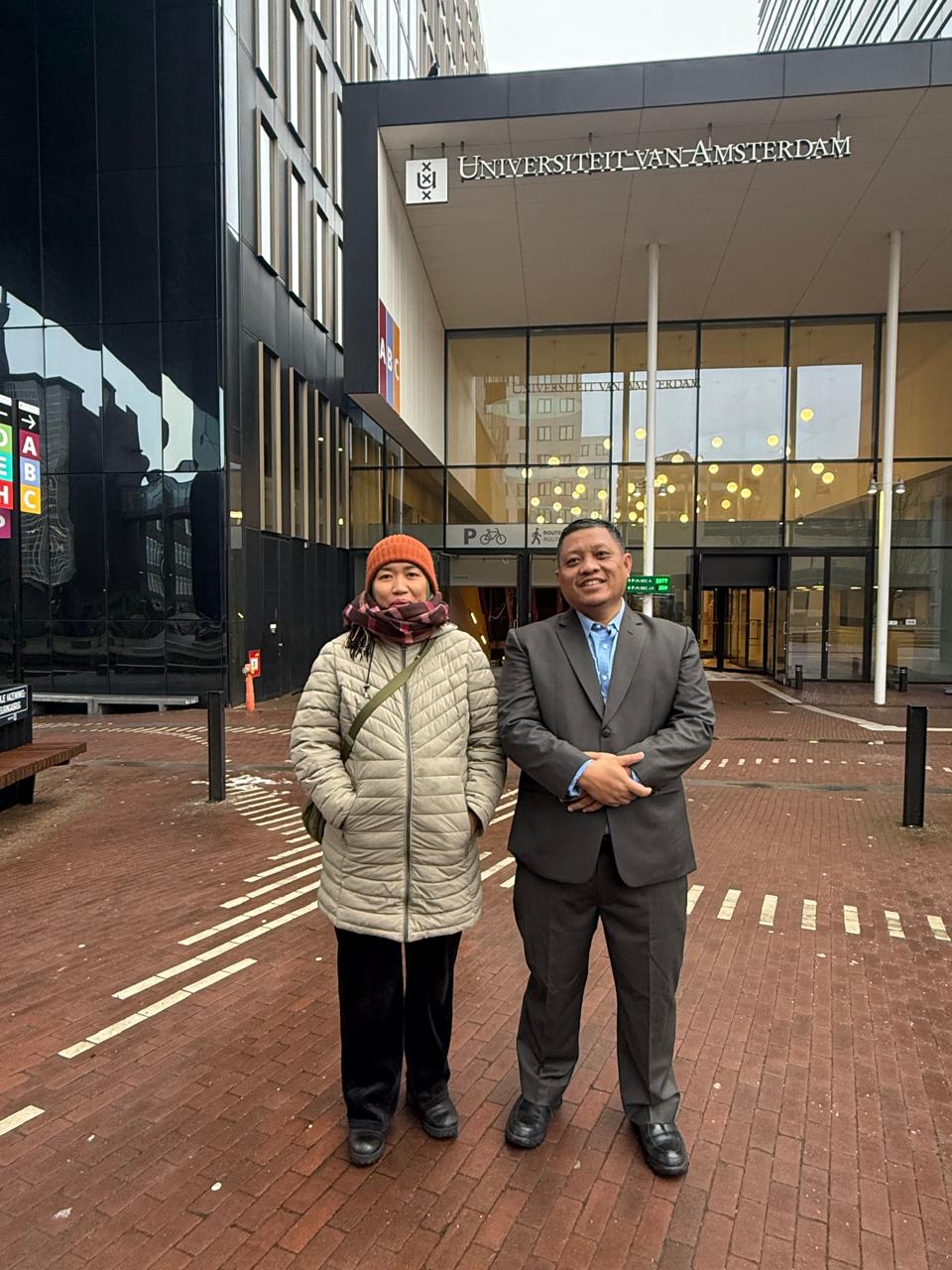
My presence in Amsterdam became more than just attending an academic event. I met and discussed with various Indonesian diaspora communities—professionals, entrepreneurs, long-term residents, and, importantly, PhD students in the Netherlands. They were not just warm discussion partners but a real support system, even providing me with a place to stay. From them, I learned that the diaspora is not just a group of individuals living abroad; they are a social, economic, and intellectual network vital for institutional development back home.
I also had the opportunity to meet Prof. Mahfud MD, who was there for the doctoral defense of his son, Dr. Ikhwan, completing his studies just two days after Nila. Our meeting became a space for dialogue that enriched my perspective on national issues, law, democracy, and the intellectual responsibility of the diaspora. His message: “Never tire of loving Indonesia.” Additionally, I joined a vibrant discussion community led by Indonesian activists, spearheaded by Pak Siswo, a former lecturer from ISI Yogyakarta. We discussed social issues, justice, and the future of Indonesia from a global lens.
Institutional Reflections: The University of Amsterdam
Back in the campus environment, the University of Amsterdam (UvA) left a lasting impression. It is not just prestigious; it is a system that works. Academic and administrative processes are integrated through transparent, efficient digital systems. This allows faculty and students to focus their energy on research and discourse rather than being held hostage by exhausting bureaucracy.
Campus facilities are not presented as luxuries but as a form of institutional responsibility toward academic justice. Comfortable study spaces, vast literature access, and a focus on mental health create a humane environment. The relationship between lecturer and student is dialogic, intellectually equal, and critical, yet respectful. The atmosphere of education there is truly “alive.”
Ms. Tengku Nila Fadhlia’s doctoral inauguration was a symbol of this journey. It proved that our people can stand equal on the world academic stage when given the right space, opportunity, and system support. This pride is not just personal; it is institutional and national.
Cultural Lessons and Social Advocacy
Interacting with the Dutch people provided cultural lessons relevant to psychology. They are direct, honest, disciplined, and respect privacy. Their clear rules create psychological safety. Assertive communication reduces latent conflict, and punctuality is a form of mutual respect. These values align with modern psychological principles and are worth reflecting upon in our own academic culture.
The most moving experience came from interacting with activists assisting undocumented Indonesian migrants. Here, psychology reveals its most humane face. Trauma, anxiety, fear, and hope coexist. This reaffirmed that psychology is not just about theories and classrooms; it is about social justice and advocacy for the vulnerable. I was even asked to create a motivational video for a community of 400 migrants, applying counseling principles to their lived reality.
Conclusion: Bringing Amsterdam Home
I returned to Indonesia not with a suitcase of souvenirs, but with a suitcase of experiences, reflections, and ideas. This journey reinforced my belief that the Faculty of Psychology at UIR has the potential to grow into a powerhouse—strong in system, international in orientation, yet anchored in its Islamic identity and sensitive to human rights and public policy.
Amsterdam is not to be copied blindly; it is to be studied critically. We have our own context and challenges. However, the values of order, academic integrity, openness, and the defense of human dignity are universal.
This journey reminded me that the task of a Dean is not just to manage a faculty, but to guard a collective dream. A dream of a psychology that is meaningful, just, grounded, and contributory to the people and the nation. And often, that big dream starts with a single email, a promise, a mother’s prayer, and the courage to depart.